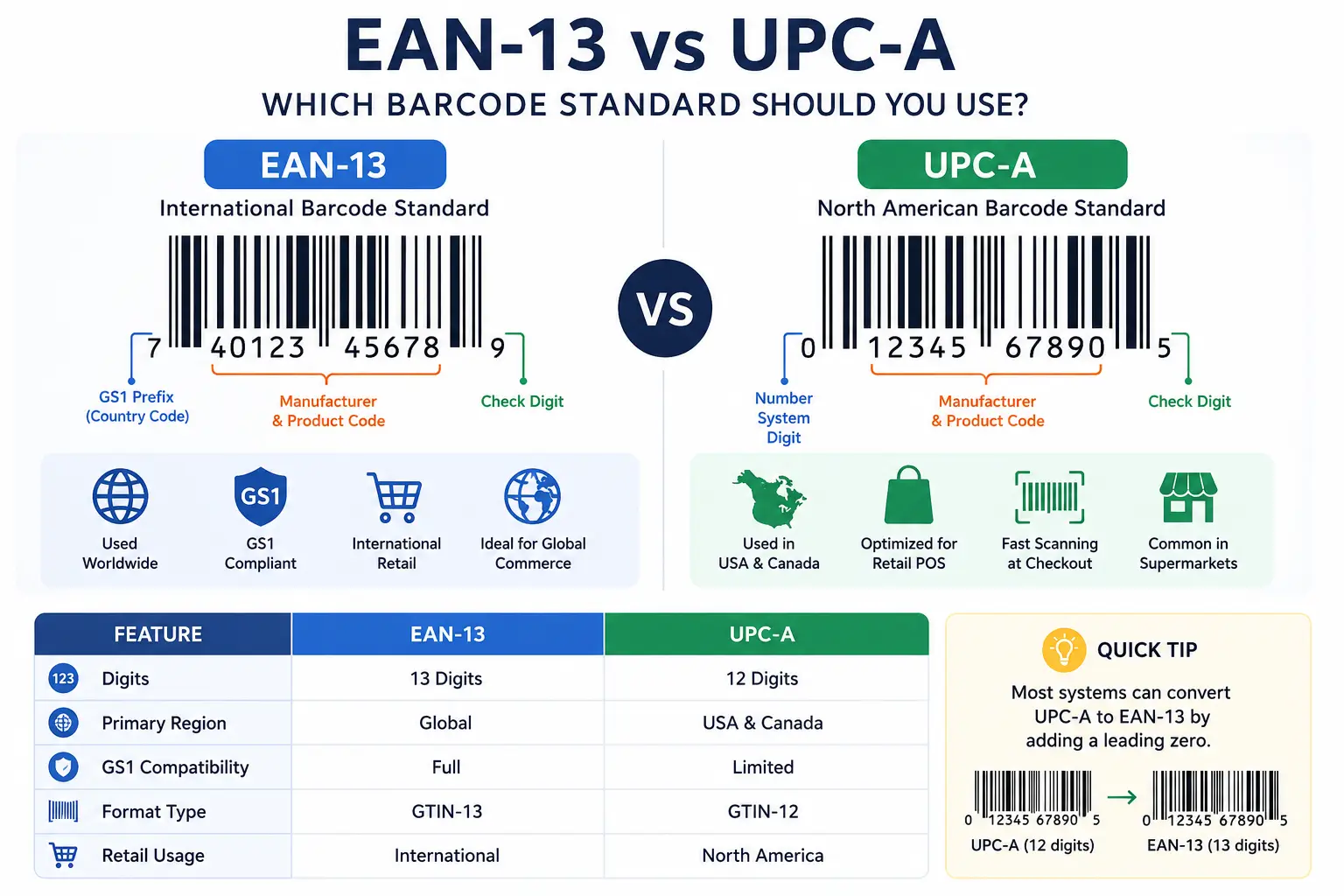
Retail comparison
EAN-13 vs UPC-A: Which Retail Barcode Should You Print?
Both symbols carry a Global Trade Item Number for point-of-sale scanning. The practical difference is length and how the number is written: UPC-A shows 12 digits (GTIN-12); EAN-13 shows 13 digits (GTIN-13). A UPC-A number is the same GTIN as an EAN-13 that starts with a leading zero.
Open the generatorDirect comparison
Choose the symbol that matches how trading partners expect the GTIN to appear on the pack -- not a preference for looking European or looking American.
| Topic | UPC-A | EAN-13 |
|---|---|---|
| Digits under the bars | 12 | 13 |
| GS1 identifier name | GTIN-12 | GTIN-13 |
| Check digit | Last digit, GS1 Modulo-10 | Last digit, same Modulo-10 method |
| Where you still see it most | United States and Canada retail packaging | Most other retail markets, and as the 13-digit form of a GTIN |
| Same-item example | 036000291452 |
0036000291452 (leading zero added) |
Worked check-digit example
GS1 weights digits from the right: odd positions (counting from the right, starting at 1) x3, even positions x1. The check digit is the value that makes the sum a multiple of 10.
Payload
For UPC-A, use 11 data digits such as 03600029145.
Check digit
The check digit is 2, so the full UPC-A is 036000291452.
EAN-13 twin
The matching EAN-13 is 0036000291452 -- same GTIN, leading zero added.
In Qrivio
Enter 11 digits for UPC-A or 12 for EAN-13; a wrong full check digit is rejected.
Do not invent a different 13th digit. Leading-zero expansion is the standard way to write the same GTIN-12 as GTIN-13. Changing other digits creates a different identifier.
When to print EAN-13 vs UPC-A
Follow the GTIN you are licensed to use, then match the market's expected symbol style.
Prefer UPC-A when
US / Canada artwork specs
GTIN managed as GTIN-12
Buyer asks for 12 digits
Local print vendors and brand templates still often specify UPC-A artwork.
Prefer EAN-13 when
Export / multi-market POS
Catalogued as 13 digits
Guidelines show 13 HRI
Including a zero-padded GTIN-12 written as GTIN-13. Do not use EAN-8 as a fake short UPC.
Printing notes that affect scans
Magnification Keep size within the range your printer and GS1 General Specifications allow. Shrinking until bars merge is a common checkout failure.
Quiet zones Leave light margins on both ends. Cropping SVG flush to the first bar is a frequent DIY error.
Uniform scale Do not stretch only width or only height. Scale the whole symbol together.
Contrast Dark bars on a light, unpatterned background. Avoid busy photo backgrounds without a solid light panel.
Marketplace listing checklist
Before you generate artwork for Amazon, other marketplaces, or retailer portals, confirm the number -- not just the bars.
Ownership
The number is from your GS1 capacity or another authorized source your channel accepts.
Exact digits
Catalog GTIN matches what you encode. No transposed digits or borrowed competitor codes.
Scan proof
Print at final size with quiet zones. Scan with a phone and a retail-style reader if you have one.
A free generator draws the symbol; it does not register the product with GS1 or approve a marketplace catalog entry. Product GTIN barcodes are not Amazon logistics labels -- see EAN-13 for Amazon.
FAQ: EAN-13 and UPC-A
Can one product use both? Yes, when they represent the same GTIN (GTIN-12 and its leading-zero GTIN-13 form). Do not assign two unrelated numbers to the same consumer unit.
Will a UPC-A scan in Europe? Most modern POS that read EAN/UPC can decode both. Teams still often print EAN-13 so the human-readable line matches local expectations.
Does online generation license the GTIN? No. Licensing comes from GS1 or another authorized source. The generator only creates artwork for numbers you already have the right to use.
What this page is not Not EAN-8 vs UPC-A, not QR vs retail barcodes, not ITF-14 carton codes. Those are separate decisions.