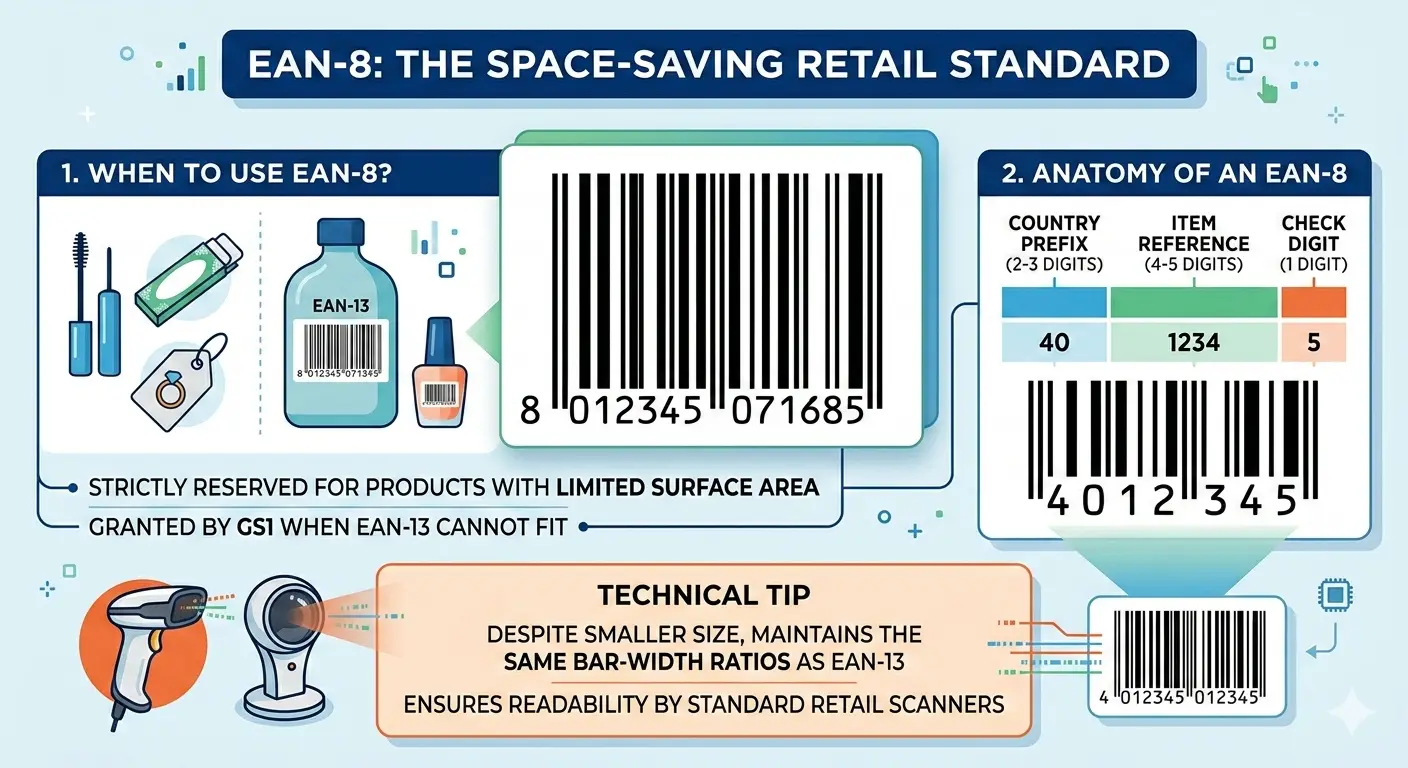
Retail GTIN-8
EAN-8 for Small Packs: GTIN-8 vs Shrinking EAN-13
EAN-8 exists because some retail units are physically too small for a full-size EAN-13 panel -- not because designers scaled a thirteen-digit symbol down until the bars fused.
Generate EAN-8Do you need GTIN-8?
Ask for GTIN-8
When the pack truly cannot carry a scannable EAN-13 at allowed magnification and quiet zones, and an eight-digit GTIN is allocated.
Keep GTIN-13
When the pack can fit a compliant EAN-13, or retailers expect the same thirteen-digit identity as larger siblings.
Never invent
Do not truncate a GTIN-13, invent eight digits, or draw EAN-8 bars around unassigned numbers.
Shrinking EAN-13 is not EAN-8
Real EAN-8
7 data + check
Different symbol length for a different identifier length (GTIN-8), allocated through GS1 processes.
Scaled EAN-13 artwork
still 13 digits
Bars get too narrow or quiet zones vanish. Scanners fail -- the symbol does not become EAN-8.
7 + check structure
GTIN-8 = seven data digits + one Modulo-10 check digit (same GS1 check family as EAN-13 and UPC-A). Qrivio can draw the symbol for a valid eight-digit string; allocation and retailer acceptance remain your responsibility.
| EAN-8 | EAN-13 | |
|---|---|---|
| Digits | 8 (GTIN-8) | 13 (GTIN-13) |
| Typical driver | Severe pack-face space after proper allocation | Default retail consumer-unit identity worldwide |
| "Make it fit" mistake | Using EAN-8 without an allocated GTIN-8 | Undersizing bars until no-reads appear |
| Qrivio input | Valid 8-digit GTIN (check verified) | 12 data digits or valid full 13 |
Sequential batches advance the data payload and recalculate the check digit -- same family logic as EAN-13. Overflow past the original digit length is blocked instead of silently wrapping.
Blister packs and print reality
Blister cards, lip balms, single-dose sachets, and mini cosmetics are where EAN-8 conversations usually start. Even an eight-digit symbol still needs a minimum X dimension and left/right quiet zones. Foil glare, perforation lines, and curved surfaces can destroy contrast.
If the panel is too small Prefer a larger card face, hang-sell header, or different pack architecture -- not a further shrink.
Validate scanners Use retail-class scanners, not only phone apps. Soft desk light is not checkout lighting on reflective foil.
Print method Thermal transfer on a label glued to the blister often outperforms heroic direct print on metallized film.
Vanity short codes Marketing short codes are not GTIN-8. Keep vanity text beside a properly allocated GTIN symbol.
Misuse gallery
Quiet-zone crowding Logos pushed into left/right clear areas until scanners see noise.
Truncating GTIN-13 Dropping five digits does not create a valid GTIN-8 for the same item.
Catalog mismatch EAN-8 on the unit and a different GTIN-13 in EDI for the same trade item.
Shared short number One GTIN-8 reused for two flavours because "the pack is tiny."
File named ean8.ai Artwork that still encodes thirteen digits.
Marketplace scrape Copying eight digits from another listing without ownership.