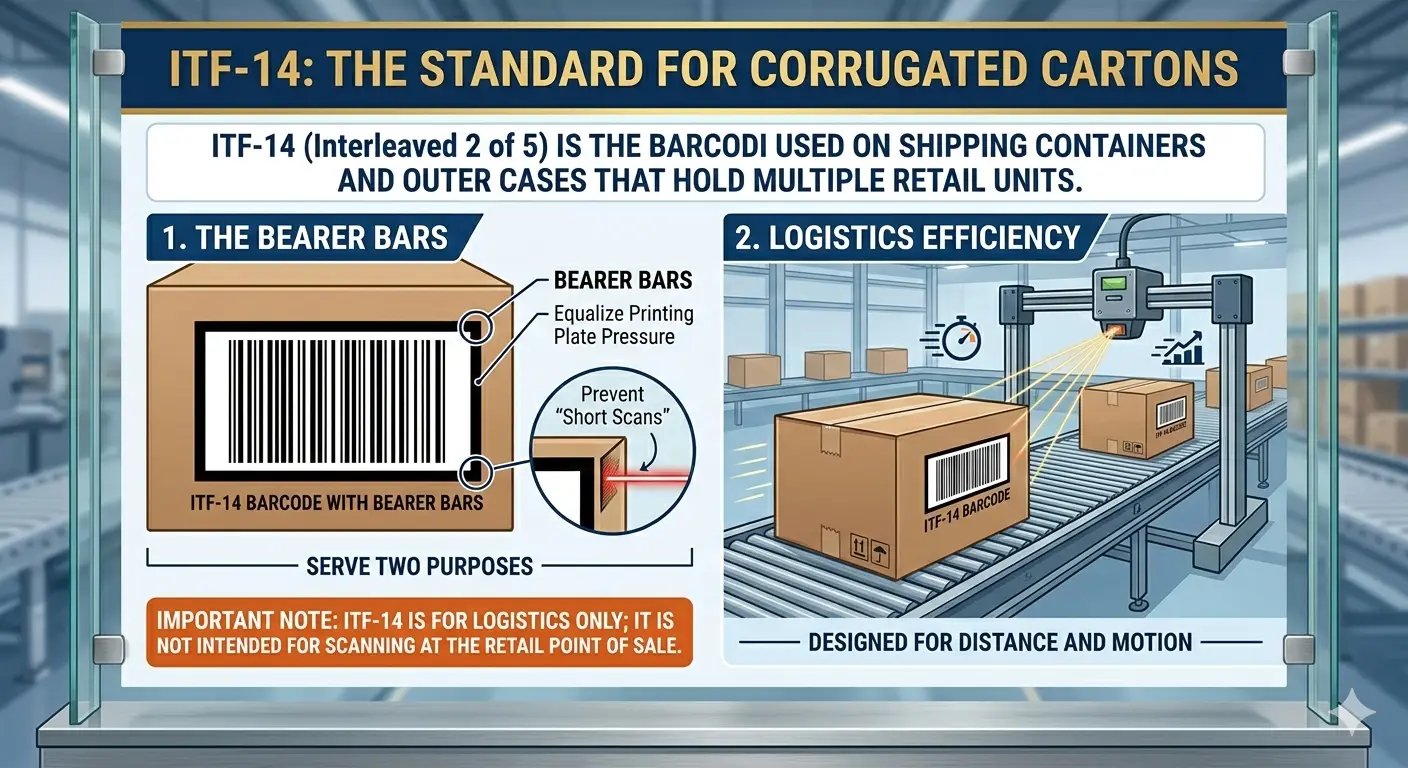
ITF-14 barcode for logistics

ITF-14: The Standard for Corrugated Cartons

Efficient logistics depends on fast and accurate product identification. Every day, millions of shipping cartons move through warehouses, distribution centers, fulfillment facilities, and transportation networks before reaching retailers or customers. To keep this process organized, businesses rely on barcode standards specifically designed for logistics rather than retail checkout.

One of the most widely used logistics barcode formats is ITF-14 (Interleaved 2 of 5). Unlike retail barcodes such as EAN-13 or UPC-A, ITF-14 is intended for identifying shipping cartons and outer packaging that contain multiple retail products. Its durable design, excellent readability, and compatibility with automated warehouse systems have made it a trusted standard throughout global supply chains.

Whether products are transported across a single country or shipped internationally, ITF-14 helps manufacturers, distributors, and retailers track shipments accurately while improving warehouse efficiency and reducing handling errors.

What Is ITF-14?

ITF-14 is a barcode symbology based on the Interleaved 2 of 5 encoding method. It is specifically designed to represent a 14-digit Global Trade Item Number (GTIN-14), allowing businesses to identify cartons, cases, and shipping units rather than individual retail products.

Instead of being scanned at supermarket checkout counters, ITF-14 is typically read throughout the logistics process, including manufacturing facilities, warehouses, distribution centers, freight terminals, and retail receiving departments.

Because corrugated cardboard often provides a rougher printing surface than consumer packaging, ITF-14 was developed to remain highly readable even under demanding industrial conditions.

Why ITF-14 Exists

Retail barcodes such as EAN-13 and UPC-A are optimized for consumer products displayed on store shelves. Shipping cartons, however, have completely different requirements. Large cartons move rapidly through conveyor systems, are stacked on pallets, and are frequently scanned from several feet away.

ITF-14 was created specifically to address these logistics challenges. Its structure allows reliable scanning on corrugated cardboard while supporting automated handling systems used throughout modern supply chains.

Using a dedicated logistics barcode also helps distinguish shipping containers from the retail products stored inside them, reducing confusion during warehouse operations.

Where ITF-14 Is Used

ITF-14 is commonly found anywhere products move through the supply chain before reaching retail shelves.

  • Manufacturing facilities
  • Packaging lines
  • Distribution centers
  • Warehouse inventory systems
  • Third-party logistics providers (3PL)
  • Freight terminals
  • Palletized shipments
  • Wholesale distribution
  • Retail receiving departments
  • International shipping operations

Because these environments often process thousands of cartons every hour, barcode reliability is essential for maintaining efficient workflows.

Understanding the GTIN-14 Structure

Every ITF-14 barcode represents a fourteen-digit GTIN. Each section contributes to identifying the shipping unit within the global GS1 identification system.

  • Packaging Indicator – Identifies the packaging level.
  • Company Prefix – Identifies the manufacturer or brand owner.
  • Item Reference – Identifies the packaged product.
  • Check Digit – Automatically validates scanning accuracy.

The check digit is calculated mathematically and helps barcode scanners detect common reading errors before product information enters warehouse management systems.

Built for Corrugated Packaging

Unlike smooth retail labels, corrugated cardboard presents unique printing challenges. The uneven surface, printing pressure, and natural texture of cardboard can affect barcode quality if the wrong symbology is used.

ITF-14 is specifically designed to tolerate these conditions. Its wider bars and spaces remain highly readable even when printed directly onto shipping cartons using industrial printing equipment, making it one of the most dependable barcode standards for logistics packaging.

The Purpose of Bearer Bars

One of the most distinctive features of an ITF-14 barcode is the thick rectangular border that surrounds the barcode. These horizontal bars, known as Bearer Bars, are far more than a visual characteristic—they play an important role in improving printing consistency and scanning reliability.

During high-speed printing on corrugated cardboard, pressure is not always distributed evenly across the printing plate. Bearer Bars help balance that pressure, producing cleaner bars and reducing distortion that could otherwise affect readability.

Bearer Bars also help prevent a scanning problem known as a short scan. If a laser scanner crosses only part of a barcode instead of the full symbol, it may read incomplete data. The surrounding bars discourage partial scans by forcing the scanner to cross the entire barcode, resulting in more reliable identification.

How ITF-14 Supports Modern Supply Chains

Modern supply chains depend heavily on automation. From the moment products leave the production line until they arrive at a retail distribution center, shipping cartons may be scanned dozens of times. ITF-14 provides a consistent identification method throughout this journey.

Warehouse Management Systems (WMS), transportation software, and automated sorting equipment use ITF-14 to verify shipments, monitor inventory movement, and reduce manual data entry. This improves operational efficiency while minimizing shipping errors.

Because every carton can be identified instantly, warehouse staff spend less time searching for products and more time processing orders, helping businesses improve productivity and customer satisfaction.

Advantages of ITF-14

  • Designed specifically for corrugated shipping cartons.
  • Excellent readability under industrial conditions.
  • Supports automated warehouse operations.
  • Reliable scanning from longer distances.
  • Compatible with global GS1 standards.
  • Performs well on conveyor systems.
  • Suitable for high-volume logistics environments.
  • Improves inventory accuracy throughout the supply chain.

ITF-14 vs EAN-13

Although ITF-14 and EAN-13 both belong to the GS1 identification system, they serve completely different purposes. Confusing the two formats can create problems in both warehouse operations and retail environments.

Feature ITF-14 EAN-13
Primary Purpose Shipping & Logistics Retail Sales
GTIN Format GTIN-14 GTIN-13
Used on Shipping Cartons Yes Rarely
Point-of-Sale Checkout No Yes
Distance Scanning Excellent Limited
Bearer Bars Yes No

In many supply chains, both barcode formats are used together. Individual retail products carry an EAN-13 barcode for checkout, while the outer shipping carton containing multiple units is labeled with an ITF-14 barcode for warehouse and transportation purposes.

Printing Recommendations

Even though ITF-14 is designed for demanding environments, correct printing practices remain essential. A poorly printed barcode may slow warehouse operations or require manual handling.

  • Maintain sufficient Quiet Zones around the barcode.
  • Do not remove the Bearer Bars.
  • Use high-contrast black bars on a light background.
  • Avoid stretching or compressing the barcode.
  • Print on flat areas of the carton whenever possible.
  • Verify barcode readability before large production runs.
  • Use vector formats such as SVG for maximum print quality.

Common Mistakes to Avoid

  • Using ITF-14 as a retail checkout barcode.
  • Printing the barcode too small.
  • Removing or modifying the Bearer Bars.
  • Using incorrect GTIN-14 data.
  • Printing on damaged or heavily folded surfaces.
  • Using low-resolution raster images for commercial printing.

Avoiding these common mistakes helps ensure that shipping cartons move efficiently through warehouses, distribution centers, and transportation networks without unnecessary scanning delays.

Best Practices for Using ITF-14 Barcodes

Implementing ITF-14 correctly involves more than simply generating a barcode. Proper placement, consistent printing, and verification procedures all contribute to reliable performance throughout the supply chain. Since shipping cartons often pass through multiple facilities before reaching their destination, even minor printing issues can result in delays, manual inspections, or inventory discrepancies.

For the best results, position the barcode on a flat, clearly visible area of the carton where automated scanners can easily detect it. Avoid placing labels over carton seams, folds, or damaged surfaces that may distort the barcode or reduce scanning accuracy.

Businesses handling high shipment volumes should also establish routine barcode quality checks as part of their packaging process. Verifying barcode readability before products leave the warehouse helps prevent costly operational problems later in the distribution chain.

  • Use high-contrast printing for maximum readability.
  • Preserve adequate Quiet Zones around the barcode.
  • Keep the original barcode proportions when resizing.
  • Always include Bearer Bars unless a specific application requires otherwise.
  • Print on clean, undamaged carton surfaces.
  • Use scalable SVG files for professional printing.
  • Test sample cartons before beginning mass production.
  • Inspect printed barcodes regularly during production runs.

Frequently Asked Questions

What is ITF-14 mainly used for?

ITF-14 is primarily used to identify shipping cartons, outer cases, and logistics units throughout manufacturing, warehousing, transportation, and distribution operations. It is not intended for retail checkout.

Can ITF-14 be scanned at a supermarket checkout?

Generally, no. Retail checkout systems are designed to read consumer-facing barcode formats such as EAN-13 or UPC-A. ITF-14 is intended for logistics processes rather than point-of-sale transactions.

What are Bearer Bars?

Bearer Bars are the thick horizontal bars surrounding an ITF-14 barcode. They improve printing consistency on corrugated cardboard and help reduce partial scans by encouraging scanners to read the complete barcode.

Can ITF-14 contain letters?

No. ITF-14 is a numeric-only barcode that encodes a 14-digit GTIN using the Interleaved 2 of 5 symbology.

Should I use PNG or SVG?

For professional packaging and commercial printing, SVG is generally recommended because it preserves perfect quality at any size. PNG is suitable for digital documents or situations where further scaling is unnecessary.

Can an ITF-14 barcode be printed directly on cardboard?

Yes. In fact, ITF-14 was specifically designed for corrugated cardboard and performs exceptionally well when printed using appropriate industrial printing methods.

Create ITF-14 Barcodes with Qrivio

Qrivio Barcode Generator makes it easy to generate professional ITF-14 barcodes for logistics, warehousing, and shipping operations. Simply enter your GTIN-14 number, customize the barcode if needed, and download high-quality PNG or scalable SVG files suitable for labels, cartons, and commercial packaging.

Whether you're preparing shipments for distributors, managing warehouse inventory, or labeling outer cartons for retail supply chains, Qrivio helps you produce standards-compliant ITF-14 barcodes that are ready for professional use.

Conclusion

ITF-14 is one of the most important barcode standards used in modern logistics. Designed specifically for shipping cartons and corrugated packaging, it provides reliable product identification throughout manufacturing, transportation, warehousing, and distribution. Features such as numeric-only encoding, GTIN-14 compatibility, and distinctive Bearer Bars make it particularly well suited for demanding industrial environments.

By understanding when ITF-14 should be used, following recommended printing practices, and maintaining high barcode quality, businesses can improve inventory accuracy, reduce scanning errors, and support more efficient supply chain operations. When combined with professional vector output from Qrivio, ITF-14 barcodes provide a dependable solution for organizations handling products at every stage of the logistics process.

2026 Copyright © Qrivio Barcode | All rights reserved.