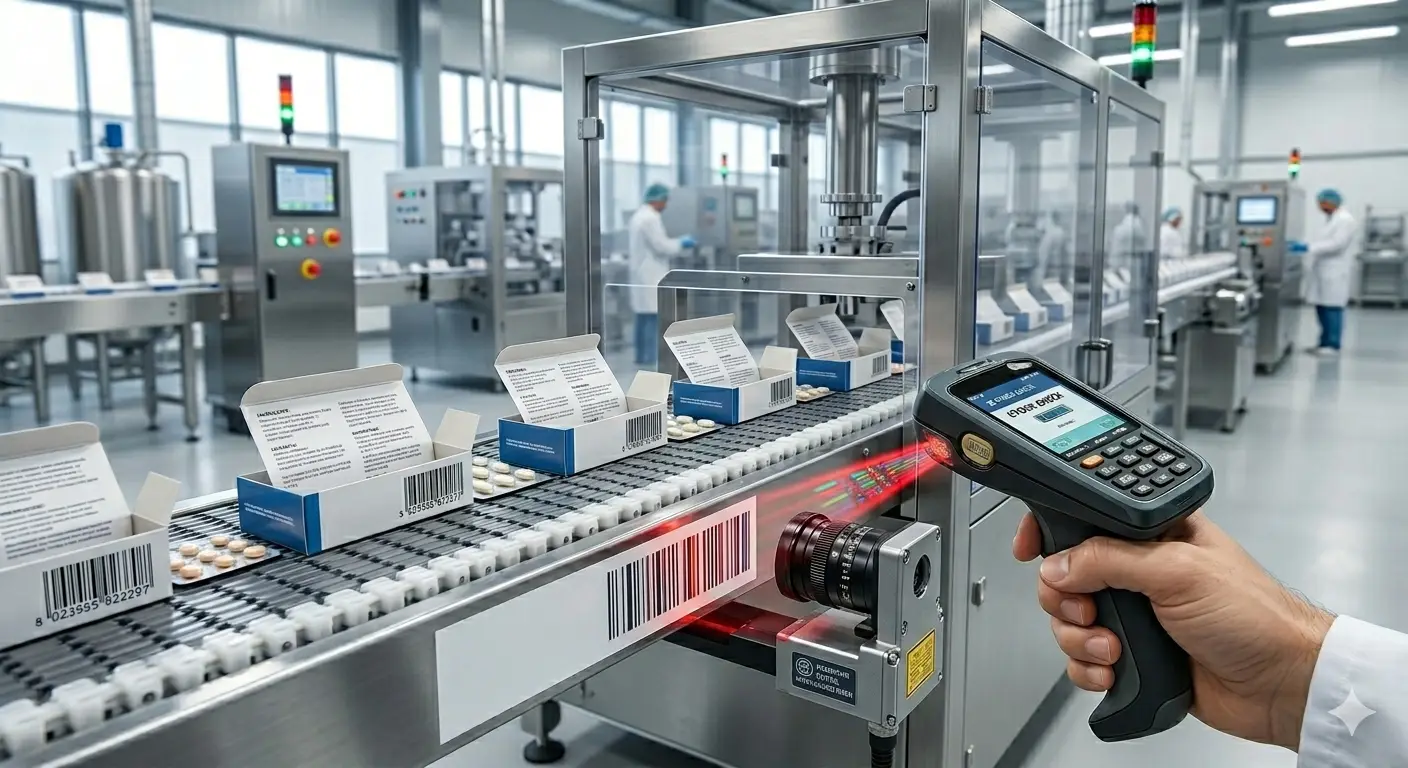
Pharmacode barcode example
Pharmaceutical Packaging Control

Pharmacode Barcode: Packaging-Line Verification & Machine-Vision Guide

A pharmaceutical production reference for Pharmacode covering narrow/wide bar encoding, one-track verification, line-camera behavior, recipe matching, print tolerances, reject logic, and the distinction between packaging control and product traceability.

Data
Numeric Value
Primary Role
Pack Verification
Environment
Production Line

1. What Pharmacode Actually Does

Pharmacode is primarily a packaging-line control symbology. It can help machinery verify that the expected carton, leaflet or other packaging component is being used for a production order.

Scope boundary

Pharmacode is not a substitute for a GTIN, serialization system or supply-chain traceability carrier.

2. Narrow/Wide Bar Representation

Classic one-track Pharmacode represents an integer as a sequence of narrow and wide bars. The reader/camera must distinguish the two bar classes reliably under real production conditions.

3. Production Recipe Mapping

Batch / OrderExpected Packaging ComponentExpected PharmacodeCamera ReadsCompareAccept / Reject

The useful control is not the barcode alone; it is the deterministic mapping between production recipe and expected packaging code.

4. Machine Vision at Line Speed

Exposure time, motion blur, illumination, camera angle and trigger timing all affect reliability. Validation at a desk or with a phone camera cannot substitute for tests at actual line speed.

5. Print Tolerance and Substrate

Condition Risk Control
Glossy carton Specular reflection Tune lighting geometry.
Ink spread Wide/narrow ambiguity Control print process.
Fine bars Insufficient pixels Increase physical size / camera resolution.
Fold area Distortion Move code to stable panel.

6. Reject and Stop Logic

A mismatch should produce a controlled machine response: reject the component/package, stop the line where appropriate, record the event and require a defined operator recovery process.

7. False Accept vs False Reject

Risk Meaning Operational Cost
False accept Wrong component passes Potentially severe quality event.
False reject Correct component rejected Downtime/waste.
No-read Reader cannot classify Requires controlled handling.

8. Pharmacode vs GS1 DataMatrix

Property Pharmacode GS1 DataMatrix
Main role Packaging verification Healthcare identification/traceability
Data richness Low High
Serial/lot/expiry Not its purpose Can be encoded with GS1 AIs
Typical reader Line camera 2D imager

9. Validation and Change Control

When artwork, printer, ink, carton stock, camera, lighting or line speed changes, revalidate the complete inspection chain. A code that was reliable under the old process may not remain reliable after a seemingly minor production change.

10. Failure Investigation

Symptom Investigate
Intermittent no-read Lighting, blur, print contrast, focus.
Wrong component accepted Recipe mapping and comparison logic.
Many false rejects Tolerance thresholds and print variability.
Works only at slow speed Exposure/trigger/camera resolution.

11. Packaging-Line Release Criteria

Verify the packaging-code master data, artwork, print sample, camera settings, production speed, accept/reject thresholds, reject mechanism, event logging and operator recovery procedure.

12. One-Track Numeric Range

One-track Pharmacode represents a bounded positive integer rather than an arbitrary character string. Encoding algorithms derive the narrow/wide sequence from the numeric value through repeated arithmetic steps. Production software should reject values outside the supported range rather than wrapping or truncating them.

13. Orientation and Camera Setup

Packaging-line readers may encounter codes in a consistent orientation, but camera placement still has to account for package travel direction, lens distortion, and depth variation. Validation should include the worst-case position and speed expected on the line, not only nominal alignment.

14. Artwork Change Control

Packaging artwork revisions can move the code, alter neighboring graphics, change ink coverage, or change the substrate. Because machine-vision performance depends on the complete optical scene, every relevant artwork or process change should trigger an agreed verification step.

15. Numeric Assignment Governance

The Pharmacode value should be allocated through controlled packaging master data. Reusing the same code for unrelated packaging components reduces the value of automated verification because the camera can no longer distinguish those materials. Maintain a documented relationship between product, packaging component, artwork revision and expected Pharmacode value so production changes remain auditable.

16. Vision-System Thresholds

Machine-vision software converts the captured image into measurements used to classify bars. Thresholds that are too permissive can increase false accepts; thresholds that are too strict can increase false rejects. Validation should therefore establish an operating window using representative good and intentionally poor samples, rather than tuning the reader only until one ideal label passes.

17. Packaging-Line Validation Study

A meaningful Pharmacode validation study should use more than a single approved carton. Assemble samples representing expected process variation: light and dark printing, minor registration shifts, different carton lots, normal surface gloss, slightly different package positions, and the highest intended line speed. Include intentionally defective or incorrect samples so the inspection system's reject behavior is tested as seriously as its accept behavior.

Record the camera model, lens, working distance, exposure, illumination geometry, trigger settings, software thresholds, conveyor speed, and packaging orientation. If these parameters are not documented, a later maintenance change can alter performance without anyone realizing that the validated operating condition has changed. Production teams should know which parameters are controlled and which may vary.

The acceptance criterion should consider false accepts, false rejects, and no-reads separately. A system tuned only to minimize rejects can become too permissive and allow incorrect packaging to pass. A system tuned only for perfect discrimination can create excessive downtime. The correct operating window balances these outcomes based on product-quality risk and the line's defined control strategy.

2026 Copyright © Qrivio Barcode | All rights reserved.