Product how-to
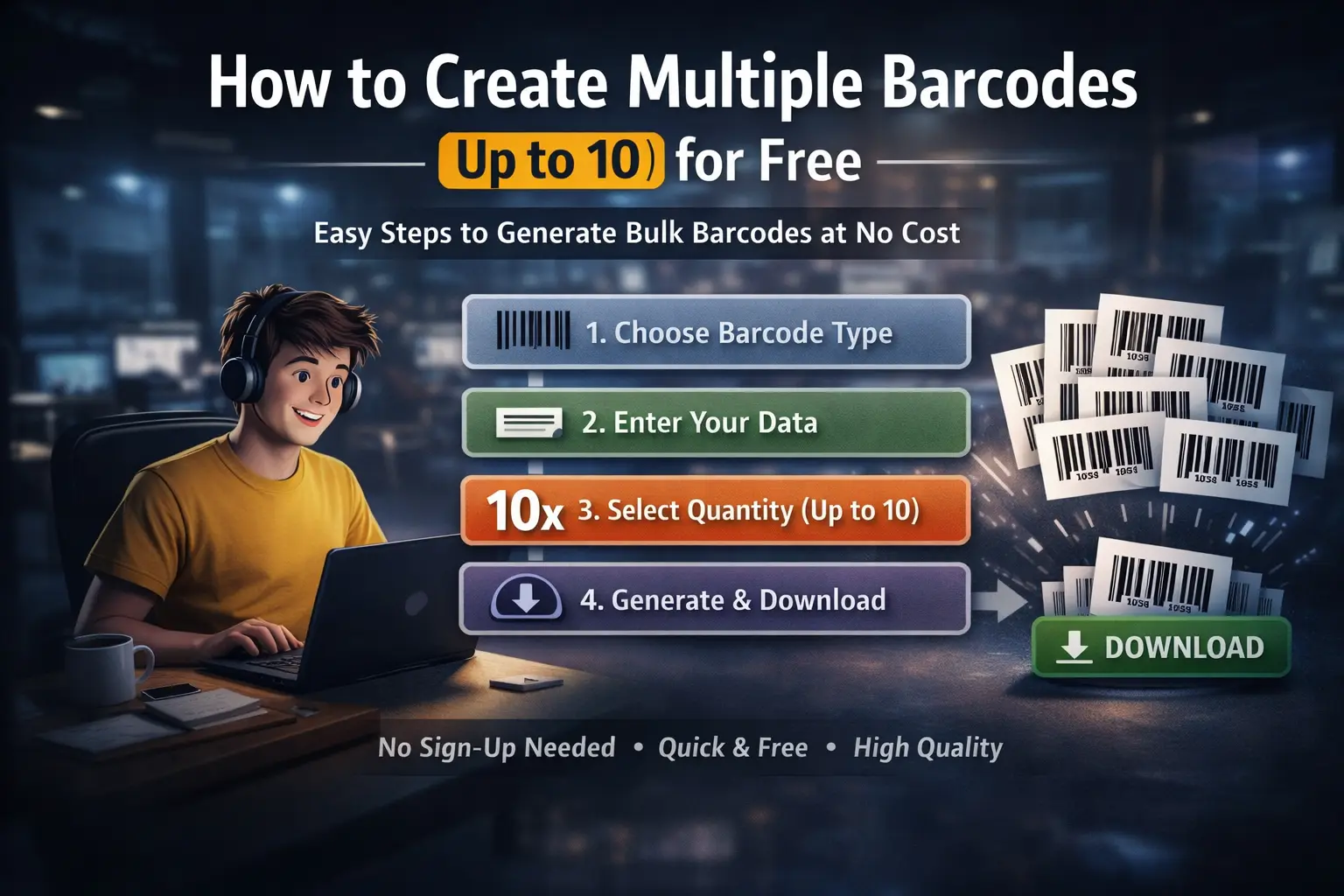
How to Create Multiple Barcodes (Up to 10) for Free
A practical guide to sequential batches on the Qrivio home-page generator: which symbologies support a count greater than one, how the next value is calculated, and how to avoid the common mistake of gluing a digit onto the end of the string.
Open the generatorFour steps on the generator
Everything happens in the Free Online Barcode Generator block. You do not need an account. One run can produce at most ten symbols.
Choose type
Pick QR, Code 128, Code 39, ITF-14, MSI, EAN-13, EAN-8, UPC-A, or Pharmacode. QR is single-only.
Enter the start
Type the first value in your sequence — for example ABC-12345 or twelve EAN digits.
Set count 1–10
Use Generate up to 10. Values above ten return an error instead of a silent trim.
Generate & download
Check every preview caption, then download PNG, JPG, or SVG for the whole batch.
Increment the last number — do not append
For Code 128 and Code 39, Qrivio finds the trailing digit run and adds one to that integer
while keeping the same digit width. The prefix stays untouched.
It must never concatenate the count onto the string (that produces invalid IDs such as
ABC-123451).
Correct sequence
ABC-12345
ABC-12346
ABC-12347
ABC-12348
Trailing block 12345 becomes 12346, 12347, 12348.
Wrong (string append)
ABC-12345
ABC-123450
ABC-123451
ABC-123452
That pattern appears when software does "ABC-12345" + 1 in JavaScript. Qrivio does not do this.
What “sequential” means by family
Each symbology family advances a different part of the payload. Use this table before you plan a batch so the preview matches your spreadsheet or WMS export.
| Type | What increments | Example |
|---|---|---|
| Code 128 / Code 39 | Trailing digits only (prefix and punctuation stay fixed) | SKU0001 → SKU0002ABC-12345 → ABC-12346 |
| EAN-13 / EAN-8 / UPC-A / ITF-14 | Payload before the check digit; check digit is recalculated with GS1 Modulo-10 | 4006381333931 → 4006381333948 |
| MSI / all-digit Code 128 | Whole digit string as a fixed-length integer | 987654 → 987655 |
| Pharmacode | Integer +1, must stay between 3 and 131070 | 1234 → 1235 |
| QR Code | Not sequential — count is forced to 1 | One URL or text string per run |
Worked EAN-13 batch (count = 3)
Enter 400638133393 (twelve data digits) or the valid full GTIN 4006381333931,
then set count to 3. The payload advances; the thirteenth digit changes as required.
4006381333931
4006381333948
4006381333955
Do not treat the full thirteen-digit string as a plain integer.
Bumping …3931 to …3932 leaves a wrong check digit and will be rejected
if you paste it as a “full” number later.
Errors you will see on purpose
The generator blocks bad batches instead of guessing. That keeps labels from looking valid while encoding the wrong ID.
Wrong check digit A full GTIN with an incorrect last digit is blocked; the message shows the digit that belongs with that payload.
Count above 10 Returns an error. The tool will not silently generate only the first ten.
No trailing digits Code 39 / Code 128 text without a numeric suffix cannot sequence when count is greater than one — add something like 001 at the end.
Overflow An EAN sequence that would grow past the original digit length (for example starting near all nines) stops with an overflow message.
Choose an output format
Pick the format before you download. You can regenerate and switch formats without changing the data.
SVG
Best for packaging artwork and print vendors. Scales cleanly; keep quiet zones when you place the file in a layout.
PNG
Quick digital proofs and label tests. Files include quiet-zone padding so bars are not flush to the image edge.
JPG
Use when a portal rejects transparency and requires a solid white background behind the symbol.
Before you print the batch
Match every preview caption to the IDs in your spreadsheet or WMS export. For retail GTINs, confirm you are authorized to use those numbers — drawing bars does not create a GS1 licence. Scan the first and last label with the same class of scanner you will use in production. Do not crop SVG flush to the first bar; quiet zone matters as much as bar width. Browsers may ask permission for multiple downloads — allow them, or download one format at a time.
Warehouse naming (bin vs SKU strategies) belongs in the bulk warehouse guide, not in this product how-to.